
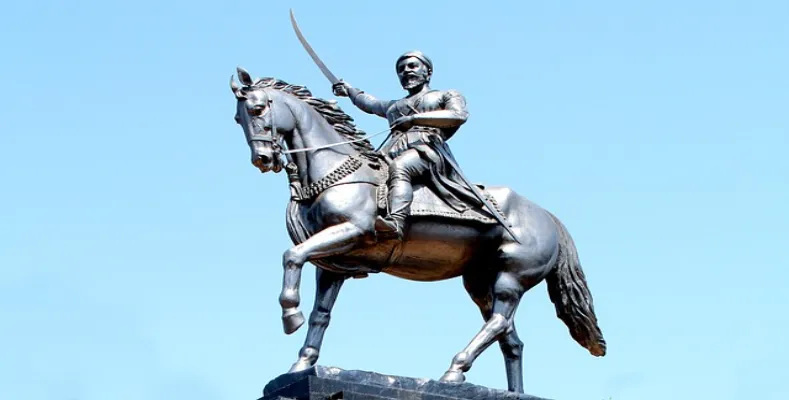
My Favourite Historical Figure | Chhatrapati Shivaji Maharaj was a prominent Maratha warrior and the founder of the Maratha Empire.
History is a tapestry woven with the stories of remarkable individuals who have shaped civilizations, cultures, and destinies. Among these illustrious figures, one name that shines brightly in Indian history is Chhatrapati Shivaji Maharaj. Shivaji Maharaj was a fearless warrior and a visionary leader. He was also a staunch protector of his people. He is my favourite historical figure. He also serves as a symbol of pride and inspiration for millions of Indians. (My Favourite Historical Figure)
Table of Contents
Early Life and Background
Shivaji Maharaj was born on February 19, 1630, at the Shivneri Fort in present-day Maharashtra. His father, Shahaji Bhosale, was a Maratha general who served the Deccan Sultanates. His mother, Jijabai, played a pivotal role in shaping his personality. Jijabai instilled in young Shivaji a deep sense of devotion, justice, courage, and pride in his culture and religion. She would often narrate stories from Indian epics like the Ramayana and Mahabharata. These tales nurtured a warrior spirit in him from an early age.
From a young age, Shivaji showed signs of extraordinary leadership, intelligence, and bravery. He formed a small army with the local youth. Shivaji began taking control of forts and territories from the Bijapur Sultanate. He displayed military brilliance and unmatched courage. (My Favourite Historical Figure)
The Foundation of the Maratha Empire
Shivaji Maharaj’s unique attribute among rulers of his time was his vision to establish a sovereign Hindu kingdom. His goal was to create a region free from foreign domination. The Indian subcontinent was largely under the control of the Mughal and Deccan Sultanate powers. Shivaji’s ambition to establish Swarajya (self-rule) was revolutionary.
Shivaji began his expansion with the capture of Torna Fort in 1645. He systematically grew his kingdom through strategic warfare. He also used diplomacy and administrative acumen. His military campaigns were characterized by guerrilla tactics, now known as Shiva Sutra or Ganimi Kava. These tactics emphasized mobility, surprise attacks, and deep knowledge of terrain.
He was not just a warrior but a brilliant administrator and planner. His forts were well-defended, his navy guarded the Konkan coast, and his army was disciplined and loyal. With these resources, he carved out a kingdom that stretched from the Konkan coast to central India. (My Favourite Historical Figure)
Coronation and Administration
In 1674, Shivaji was coronated as Chhatrapati (sovereign king) at Raigad Fort, marking the formal beginning of the Maratha Empire. This was a significant event in Indian history. It symbolized a successful resistance against centuries of foreign rule. It also marked the establishment of indigenous sovereignty.
Shivaji Maharaj established a progressive administration based on justice and welfare. He set up a centralized system of government with various departments and ministers. His Ashta Pradhan Mandal (Council of Eight Ministers) helped him manage the affairs of the state efficiently.
Unlike many rulers of his time, Shivaji promoted religious tolerance. He was a devout Hindu. However, he respected all religions. He ensured that places of worship for all communities were protected under his rule. He treated women with great respect. He never allowed their mistreatment, even during warfare. This was a stark contrast to the practices common during his era. (My Favourite Historical Figure)
Military Brilliance and Naval Strength
One of Shivaji Maharaj’s most remarkable achievements was his naval foresight. He understood the importance of securing India’s western coastline. He built a strong naval force. He also established several strategically located sea forts like Sindhudurg and Vijaydurg. He is often credited as the Father of the Indian Navy. (My Favourite Historical Figure)
His military genius was evident in his countless battles against larger and more powerful enemies. He faced the Mughals led by Aurangzeb. He also fought against the forces of Bijapur and Golconda. His escape from Agra in 1666 was daring and legendary. During this time, he was held captive by Aurangzeb. This event remains one of the most famous episodes in Indian history. He was disguised in baskets used to carry sweets. He managed to evade tight Mughal security. He returned to Maharashtra to continue his fight for freedom. (My Favourite Historical Figure)
Legacy and Impact
Chhatrapati Shivaji Maharaj’s legacy is eternal. He laid the foundation of the Maratha Empire. This empire would later become a formidable force in Indian politics. It played a significant role, especially during the decline of the Mughal Empire. His ideals of Swarajya, strategic governance, and inclusive policies became guiding principles for future Indian leaders.
He is remembered as a great warrior. He was also a visionary king who valued education, culture, and social justice. His governance was people-centric, and he established a model that provided internal stability, prosperity, and justice to his subjects.
Even centuries after he died in 1680, Shivaji Maharaj remains a symbol of resistance, patriotism, and leadership. Statues, memorials, and forts in his honor dot the Indian landscape, especially in Maharashtra. His life and deeds continue to be celebrated through festivals like Shiv Jayanti, folk tales, books, and movies. (My Favourite Historical Figure)
Why Shivaji Maharaj Inspires Me
Among all the figures in history, Shivaji Maharaj inspires me the most because of his unwavering commitment to justice. His fearless spirit and his ability to lead by example also inspire me. India faced immense political turmoil at that time. He rose not through inheritance or luck. Instead, his sheer will, courage, and wisdom led him.
His emphasis on moral values and efficient governance makes him an ideal leader. His respect for all cultures and religions also contributes to this. He is an example of contemporary leadership. Many leaders often seek power for personal gain. In contrast, Shivaji Maharaj used power to protect his people. He also uplifted them. He showed the world that a true leader serves his people and stands firm for his principles. A true leader does this even in the face of immense danger.
For people like me, his life offers countless lessons. These include dreaming big, fighting for what is right, respecting others, and never giving up in the face of challenges. His life story is not just history. It’s a source of inspiration. It’s also a guide for living with honour and purpose. (My Favourite Historical Figure)
Conclusion
Chhatrapati Shivaji Maharaj was more than a warrior. He was a nation builder. He was a champion of justice. He was a visionary far ahead of his time. His life reminds us of the power of determination, intelligence, and moral courage. He changed the course of Indian history. He also left behind a legacy that continues to inspire countless generations. (My Favourite Historical Figure)
For me, Shivaji Maharaj is not just a historical figure. He is a role model, a guiding light, and a timeless symbol of valor, leadership, and patriotism. That is why he will always stay my favourite historical figure. (My Favourite Historical Figure)
Related Posts
Visit our Etopcollection and “Dnyanjyot” educational websites.