
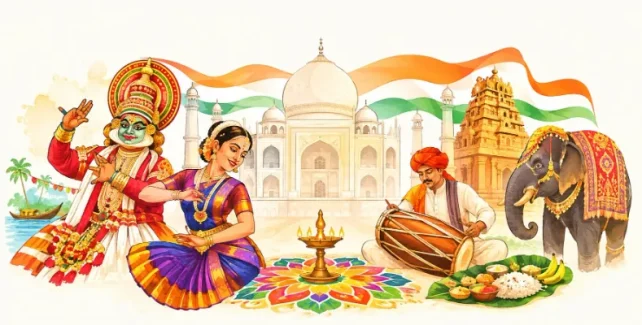
Cultural Traditions of India | Indian traditional culture is defined by deep spiritual roots, strong family bonds, rich arts, and a core philosophy of “unity in diversity” across its many regions.
India is a land of diverse cultures, languages, religions, and traditions. The cultural traditions of India have evolved over thousands of years and continue to shape everyday life, family relationships, celebrations, spirituality, arts, music, and social values. Despite regional differences, Indian culture is deeply rooted in respect, hospitality, community, and spiritual harmony.
Table of Contents
Core Values and Social Customs
One of the most recognizable Indian traditions is Namaste, a respectful greeting made by joining the palms together. It expresses humility and respect and is often understood as “I bow to the divine in you.” This simple gesture reflects the importance of mutual respect in Indian society.
The joint family system has traditionally been an important part of Indian social life. Several generations may live together under one roof, sharing responsibilities, resources, experiences, and emotional support. Although modern lifestyles have increased the popularity of nuclear families, joint-family values remain influential.
Respect for elders is another central cultural value. Older family members, teachers, and other respected individuals are traditionally treated with great honor. Younger people may seek their advice and blessings, especially during important occasions and ceremonies.
Indian hospitality is beautifully expressed through the ancient principle “Atithi Devo Bhavah,” meaning “the guest is equivalent to God.” Guests are traditionally welcomed warmly and treated with generosity, care, and respect. (Cultural Traditions of India)
Festivals and Spirituality
Indian festivals bring people together regardless of regional and cultural differences. Diwali, the Festival of Lights, is associated with light overcoming darkness. Holi, the Festival of Colors, is celebrated with colors, music, and joyful gatherings. Other major celebrations include Eid, Navaratri, and Pongal, each reflecting unique religious and regional traditions while encouraging community participation.
India is also the birthplace of Hinduism, Buddhism, Jainism, and Sikhism. Spirituality is closely connected with daily life through practices such as yoga, meditation, prayer, and religious rituals. Many Indian traditions emphasize inner peace, self-discipline, compassion, and harmony.
Another important aspect of Indian spirituality is reverence for nature. Rivers such as the Ganges hold deep religious significance, while animals such as the cow are respected in many communities. Sacred groves, trees, mountains, and other natural elements also feature prominently in traditional beliefs. (Cultural Traditions of India)
Arts, Music, and Dance
India’s cultural heritage is beautifully expressed through its classical dances. Forms such as Bharatanatyam, Kathak, and Kathakali combine movement, facial expressions, music, and storytelling to communicate religious, historical, and cultural narratives.
Indian music has two major classical traditions: Hindustani classical music, primarily associated with North India, and Carnatic music, which developed mainly in South India. Both traditions have sophisticated systems of melody and rhythm and remain influential today.
India is equally famous for its traditional crafts and textiles. Handloom weaving, intricate silk work, pottery, embroidery, and vibrant folk art showcase the creativity and craftsmanship of different regions.
In conclusion, the cultural traditions of India represent a rich blend of history, spirituality, family values, hospitality, artistic expression, and community life. From the humble Namaste to colorful festivals and timeless classical arts, these traditions continue to preserve India’s unique cultural identity while adapting to the modern world. (Cultural Traditions of India)
Conclusion
In conclusion, India’s cultural traditions reflect a vibrant tapestry of history, spirituality, and community values. From the warmth of Namaste to the joy of colorful festivals and classical arts, these traditions foster unity in diversity. As they evolve with time, they continue to uphold India’s unique heritage while enriching lives across generations. Embracing these customs enhances our appreciation for this beautiful culture. (Cultural Traditions of India)
- Cultural Heritage
- Deepavali is an Auspicious Festival
- How to Propitiate Goddess Lakshmi?
- Memorable Historical Events in India
- The story of meeting a significant other
Visit our Etopcollection and “Dnyanjyot” educational websites.