
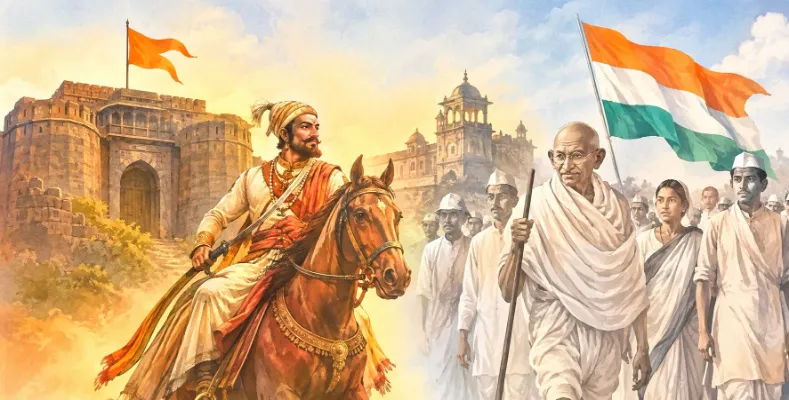
Top 2 Historical Events | Pune’s journey through Maratha Glory and India’s Freedom Movement.
If I could go back in time and witness any historical event, I would choose a moment from Pune’s extraordinary past. Known as the cultural capital of Maharashtra, Pune has played a remarkable role in shaping India’s history. From the rise of the Maratha Empire to the struggle for India’s independence, the city has witnessed events that transformed politics, society, and the course of the nation. Among all these moments, witnessing the rise of Maratha power in Pune would be an unforgettable experience. (Top 2 Historical Events)
Table of Contents
Pune and the Rise of the Maratha Empire
Pune’s connection with the Maratha Empire is closely associated with Chhatrapati Shivaji Maharaj, one of the most influential figures in Indian history. Shivaji Maharaj spent important years of his early life in the Pune region under the guidance of his mother, Jijabai, and his mentor Dadoji Konddev. The city and surrounding forts became closely connected with his vision of establishing Swarajya, or self-rule.
If I could travel back in time, I would love to witness Pune during the 17th century, when the foundations of Swarajya were being laid. Imagine walking through the historic streets and witnessing the atmosphere surrounding Lal Mahal, where Shivaji Maharaj spent part of his childhood. It would offer a rare opportunity to understand the determination and ideals that eventually contributed to the emergence of a powerful Maratha state. (Top 2 Historical Events)
Another fascinating period would be the rise of the Peshwas in the 18th century. Pune became the political and administrative centre of the Maratha Empire under the Peshwas. Shaniwar Wada, commissioned by Peshwa Bajirao I in 1732, became the heart of Maratha political power. Standing there during its golden period would provide a vivid glimpse into the grandeur, ambitions, and complexities of 18th-century Indian politics. (Top 2 Historical Events)
Pune’s Role in India’s Freedom Movement
Pune’s historical importance did not end with the Maratha era. Centuries later, the city emerged as an important centre of India’s freedom movement. Pune became associated with prominent nationalists, social reformers, journalists, and revolutionaries who challenged British colonial rule.
One of the most influential figures connected with Pune was Bal Gangadhar Tilak, popularly known as Lokmanya Tilak. Through his newspapers, public movements, and political activities, Tilak helped transform the freedom struggle into a broader public movement. His promotion of public celebrations of Ganesh Chaturthi and Shiv Jayanti also helped bring people together and strengthen social and national consciousness. (Top 2 Historical Events)
If I could witness one event from this period, I would choose a major public gathering led by Tilak. Seeing thousands of people come together with a shared desire for freedom would demonstrate how ordinary citizens gradually became active participants in India’s independence movement. (Top 2 Historical Events)
Pune was also home to important social reformers such as Mahatma Jyotirao Phule and Savitribai Phule. Their pioneering work in education and social reform challenged deeply rooted inequalities. Savitribai Phule, in particular, played a groundbreaking role in promoting education for girls. Witnessing the early days of their educational movement would provide an inspiring insight into how social change can begin with courage and determination. (Top 2 Historical Events)
Why Pune’s History Is Worth Witnessing
Choosing a historical event in Pune is not simply about seeing famous personalities or grand monuments. It is about experiencing the ideas that shaped modern Maharashtra and India. The Maratha Empire represents the pursuit of Swarajya, strategic leadership, and regional power, while Pune’s role in the freedom movement reflects education, social reform, nationalism, and resistance to colonial rule.
Today, places such as Shaniwar Wada, Lal Mahal, Aga Khan Palace, and the homes and memorials associated with social reformers and freedom fighters allow visitors to connect with different chapters of Pune’s past. (Top 2 Historical Events)
A Journey Through India’s Living History
If given the chance to travel through time, Pune would be one of my first destinations. I would choose to witness the emergence of Maratha power and then return to the city during the freedom movement to experience its changing political and social landscape.
Pune’s history reminds us that a single person or event rarely creates great transformations. They emerge from the combined efforts of leaders, reformers, educators, warriors, and ordinary citizens. From Shivaji Maharaj’s vision of Swarajya to the nationalist spirit of Lokmanya Tilak and the social revolution led by Jyotirao and Savitribai Phule, Pune continues to tell the story of courage, reform, and independence.
For anyone interested in Pune’s history, the Maratha Empire, the Indian freedom movement, and Maharashtra’s heritage, exploring these chapters offers an opportunity to understand not only where the city came from but also how its past continues to influence India today. (Top 2 Historical Events)
Visit our Etopcollection and “Dnyanjyot” educational website.