
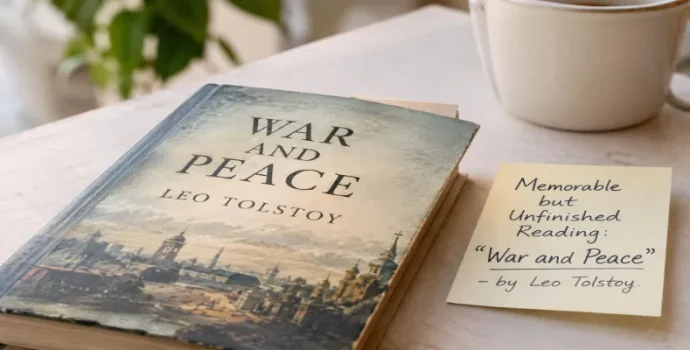
Memorable but Unfinished Reading: An epic Russian masterpiece that leaves you overwhelmed, captivated, and unfinished: ‘War and Peace ‘ by Leo Tolstoy.
Reading a classic novel does not always mean reaching the final page. Sometimes, an unfinished book can still leave a lasting impression. War and Peace by Leo Tolstoy is one such remarkable work. Although I could not complete the entire novel, the portions I read were memorable because of their powerful characters, historical setting, emotional depth, and thoughtful exploration of life. (Memorable but Unfinished Reading)
Table of Contents
A Legendary Classic
War and Peace is one of Leo Tolstoy’s most celebrated novels and is widely regarded as a masterpiece of world literature. Set against the backdrop of the Napoleonic Wars, the book combines history, family life, romance, politics, and philosophy. Even while reading only part of it, I could understand why the novel continues to attract readers across generations.
A Vast Historical Background
One of the most fascinating aspects of War and Peace is its historical setting. Tolstoy presents Russian society during the early nineteenth century and explores the impact of Napoleon’s invasion of Russia. The descriptions of war and changing political circumstances make the story feel much larger than an ordinary family drama. (Memorable but Unfinished Reading)
Unforgettable Characters
The novel introduces several complex and memorable characters, including Pierre Bezukhov, Prince Andrei Bolkonsky, and Natasha Rostova. Their personalities, ambitions, relationships, mistakes, and struggles make them feel remarkably human. Their journeys encourage readers to think about love, happiness, purpose, and personal growth. (Memorable but Unfinished Reading)
More Than a War Story
Despite its title, War and Peace is not simply a novel about battles. Tolstoy gives considerable attention to ordinary human experiences. Family relationships, friendship, marriage, social expectations, personal ambitions, and moments of happiness are equally important. This balance between historical events and private lives makes the book especially meaningful. (Memorable but Unfinished Reading)
Deep Philosophical Ideas
Another memorable feature is Tolstoy’s reflection on human nature and history. He questions how much control individuals really have over major historical events. These philosophical passages may require patience, but they add intellectual depth and encourage readers to look beyond the immediate storyline. (Memorable but Unfinished Reading)
Why I Left It Unfinished
The enormous length and detailed storytelling of War and Peace can be challenging. Its large cast, historical discussions, philosophical reflections, and multiple storylines demand considerable time and concentration. For these reasons, I was unable to finish the book. However, leaving it unfinished does not mean that the reading experience was unsuccessful. (Memorable but Unfinished Reading)
A Book Worth Returning To
An unfinished classic can sometimes become an invitation to return rather than a failure to complete. War and Peace left enough of an impression on me to make me want to revisit it. A second attempt may allow me to appreciate its deeper themes and complete the journeys of its unforgettable characters. (Memorable but Unfinished Reading)
Conclusion
My reading of War and Peace remains unfinished, but the experience was memorable. Leo Tolstoy’s ability to connect history with human emotions makes the novel timeless. It taught me that a book does not always have to be completed to influence a reader. Sometimes, even an unfinished reading journey can create curiosity, reflection, and a lasting desire to return to a great literary masterpiece. (Memorable but Unfinished Reading)
- Weirdest Coincidences
- Landmark Year in Indian History
- Revisit Beloved Books and Movies
- Top 10 Books to Rewrite the Ending
- Top 7 Books That Deserve a Sequel
- Travel Inspiration from Movies and Books
- How to Discover the Best Reference Book
Visit our “Etopcollection” and an educational website, “Dnyanjyot“