
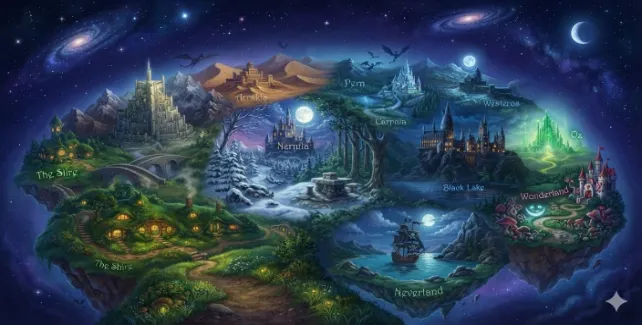
7 Fictional Worlds from Books: Westeros is a brutal feudal land of constant war, dragons, torture, and sudden murder.
Books transport us to magical kingdoms, futuristic cities, mysterious islands, and extraordinary imaginary worlds. While some fictional places seem like perfect destinations, others would turn everyday life into a nightmare. From oppressive governments and deadly competitions to supernatural threats and post-apocalyptic wastelands, some literary worlds are far scarier than they first appear. (7 Fictional Worlds from Books)
Imagine living in a society where your every move is monitored, your survival depends on winning a deadly game, or dangerous creatures lurk outside your door. These fictional settings may be fascinating to read about, but experiencing them in real life would be terrifying. Here are seven book worlds that would be among the worst places to call home. (7 Fictional Worlds from Books)
Table of Contents
1. Panem – The Hunger Games by Suzanne Collins
Panem is a dystopian nation where the wealthy Capitol controls the surrounding districts through fear, poverty, and violence. Every year, the Capitol selects children to participate in the Hunger Games, a televised competition in which contestants must fight to survive.
- Constant fear: Families live with the possibility of losing their children.
- Extreme inequality: The Capitol enjoys luxury while many districts struggle to obtain necessities.
- No real freedom: Citizens have little power to challenge the ruling authorities.
Living in Panem would mean sacrificing peace, security, and freedom just to survive. (7 Fictional Worlds from Books)
2. Oceania – 1984 by George Orwell
Oceania is a society ruled by the Party and its all-powerful leader, Big Brother. The government monitors citizens, controls information, and manipulates historical records to maintain complete authority.
- No privacy: Surveillance makes even private thoughts feel unsafe.
- Restricted information: Independent thinking and access to truth are suppressed.
- Psychological terror: Citizens risk punishment for expressing forbidden opinions.
Oceania would be a nightmare for anyone who values freedom, individuality, and the ability to speak honestly. (7 Fictional Worlds from Books)
3. Gilead – The Handmaid’s Tale by Margaret Atwood
Gilead is a totalitarian society in which women are stripped of fundamental rights and controlled by a rigid religious regime. Fertile women are forced into reproductive servitude.
- Loss of personal freedom: Women have little control over their lives.
- Strict social hierarchy: People are assigned roles according to the regime’s ideology.
- Fear and oppression: Resistance can lead to severe punishment.
Life in Gilead would mean living under constant restrictions with limited control over your own future. (7 Fictional Worlds from Books)
4. The World of The Maze Runner by James Dashner
Imagine waking up in a mysterious place surrounded by enormous walls, with no clear memories of your past. Beyond those walls lies a dangerous maze filled with deadly creatures.
- Uncertainty: You have no reliable information about your identity or circumstances.
- Physical danger: Survival requires navigating a constantly threatening environment.
- Limited escape: Finding a way out means risking your life.
The psychological pressure of never knowing whom to trust or what lies around the next corner would be exhausting. (7 Fictional Worlds from Books)
5. Westeros – A Song of Ice and Fire by George R. R. Martin
Westeros may offer magnificent castles and powerful kingdoms, but political ambition makes it an incredibly dangerous place.
- Political betrayal: Allies can become enemies overnight.
- Frequent warfare: Ordinary people suffer when powerful families fight for control.
- Supernatural threats: Beyond the political conflicts, terrifying dangers threaten the living.
Unless you belonged to a powerful and well-protected family, surviving Westeros would be a serious challenge. (7 Fictional Worlds from Books)
6. The Wizarding World During Voldemort’s Rise – Harry Potter by J. K. Rowling
Although the wizarding world offers magic and incredible possibilities, it becomes deeply frightening when Voldemort and his followers gain power.
- Discrimination: People are targeted because of their ancestry or identity.
- Political corruption: Institutions can be manipulated by dangerous individuals.
- Threats to safety: Even schools and homes can become vulnerable to attacks.
Magic might make life exciting, but it cannot guarantee safety when powerful forces spread fear. (7 Fictional Worlds from Books)
7. The Post-Apocalyptic World – The Road by Cormac McCarthy
This bleak landscape follows a father and son travelling through a devastated world where civilization has collapsed.
- Scarcity of food: Finding enough to eat becomes a daily struggle.
- Dangerous encounters: Desperation drives some survivors to commit terrible acts.
- Emotional isolation: Hope and trust become difficult to maintain.
Without functioning communities, reliable supplies, or a clear future, even the simplest daily tasks would become exhausting battles for survival. (7 Fictional Worlds from Books)
Conclusion
Fictional worlds can captivate us precisely because they explore situations far removed from ordinary life. However, the societies in these books reveal how quickly freedom, safety, and dignity can disappear under oppressive systems, relentless violence, or environmental catastrophe.
Whether it is the surveillance of Oceania, the deadly games of Panem, or the desolation of The Road, each setting reminds us how much we depend on security, compassion, and freedom. These worlds might be thrilling to explore from the comfort of a book, but living in them would be an entirely different story. (7 Fictional Worlds from Books)
Visit our Etopcollection and “Dnyanjyot” educational websites.